Concealed Water Pipe Leak Detection
Investigate suspected leaks in concealed water supply lines routed through walls, floors, screed and service channels, where the pipe route and conditions allow acoustic testing.

Home Inspection 360 provides acoustic leak detection and concealed water-pipe leakage investigation for apartments, independent houses, villas, commercial properties and residential communities. We investigate suspected leaks in bathrooms, internal walls, flooring, kitchens, utility areas, gardens, outdoor pipe routes, building openings, common areas and accessible ground or soil areas.
Where suitable, an acoustic listening device is used to listen for sound patterns associated with water escaping from pressurised pipes. Visual checks, moisture readings, thermal imaging and pressure testing may support the investigation when appropriate, available, safe and included in the agreed scope.
Acoustic listening checks · Concealed pipe investigation · Moisture cross-checks · Findings and next-step recommendations
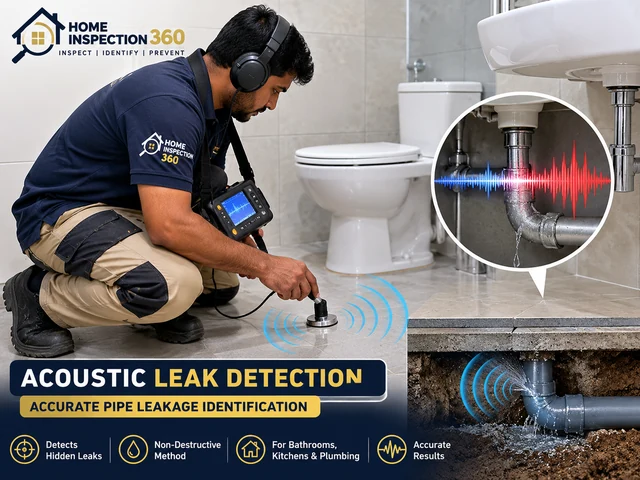
A concealed pipe leak may show up as an unexpectedly high water bill, a water meter that continues moving when outlets are closed, damp flooring, wall stains, water collecting outdoors or seepage appearing in another room or on a lower floor. The visible damp patch may be some distance from the actual leak because water can travel through screed, soil, masonry, service ducts and construction joints.
Acoustic leak detection helps investigate possible leaks by listening for sound created as water escapes from a pipe. The method works best when the leak produces a detectable sound and the pipe, water supply and surrounding conditions are suitable. Results depend on pipe material, pressure, leak size, depth, background noise, access and ground or building construction.
Our service is an investigation to narrow down likely leak areas. It is not a guarantee that every leak can be located exactly without further tests or opening-up work.
Acoustic leak detection uses sensitive listening equipment to locate suspected leaks in pressurised water pipes without breaking walls or floors first. Home Inspection 360 offers it across Chennai for concealed lines in bathrooms, walls, floors, gardens and shallow underground pipes (up to about 3 feet where conditions permit). It helps narrow down the likely leak area, but an exact leak point is not guaranteed.
We assess the accessible areas relevant to the reported symptoms. The exact testing method is selected after discussing the water supply, pipe route, property layout, access and safety conditions.
Investigate suspected leaks in concealed water supply lines routed through walls, floors, screed and service channels, where the pipe route and conditions allow acoustic testing.
Check suspected supply-pipe leakage around bathrooms, toilets, showers, washbasins and plumbing routes. Visible fittings and nearby surfaces are cross-checked for dripping, dampness and other symptoms.
Investigate damp patches, peeling paint, wet skirting, staining and suspected concealed supply pipes inside accessible internal walls. Surface symptoms alone do not confirm the source.
Assess suspected leaks beneath floor tiles, stone flooring or screed where an accessible pipe route and suitable conditions are present. Tile removal is not included unless separately agreed.
Investigate possible concealed supply-line leaks around sinks, utility rooms, washing-machine connections and other accessible plumbing routes. Drain and waste-pipe faults may require different tests.
Where access and permission are available, inspect affected ceilings, walls and floors below a suspected leak and compare symptoms with the likely plumbing route above.
Investigate suspected water-supply leaks along accessible garden pipe routes, landscaped areas and outdoor taps. Plants, irrigation systems, soil saturation and background noise can affect the assessment.
Check accessible external supply pipes near compound walls, building perimeters, outdoor wash areas, taps and service routes for signs of leakage and suitable acoustic listening points.
With prior approval, investigate accessible shared corridors, service ducts, common bathrooms, pump areas and common water-supply routes. Building-management permission may be required.
Inspect accessible pipe penetrations, sleeves, service openings and wall-floor entry points for visible gaps, water trails or dampness. A gap around a pipe can admit water but does not by itself prove a pipe is leaking.
Investigate suspected leaks in accessible underground water-supply routes using suitable listening points and supporting checks. Detection depends on pipe depth, soil type, surface finish, pipe material, pressure and ambient noise.
Where conditions permit, we can investigate suspected water-line leakage in ground or soil at an approximate depth of up to 3 feet. This is a target investigation range, not a guaranteed detection depth; the actual capability varies by site and equipment conditions.
Check accessible water-supply connections, risers, valves and nearby surfaces for signs of leakage. Tank overflow, float-valve faults and drainage issues may need separate functional checks.
Where accessible and safe, water-meter observations or suitable pressure tests may help determine whether a supply line may be losing water. Pressure testing is subject to system suitability and is not automatically included.
Moisture meter readings and thermal imaging may help compare affected and nearby surfaces where suitable. These tools support the investigation but do not independently prove a leak or identify its exact point.
Review reported leak history, previous repairs and recurring symptoms to help identify areas that may need re-testing. Earlier repair records and access to the affected route are useful.
Help distinguish suspected pressurised supply-pipe leakage from possible drainage, rainwater, waterproofing or surface-seal defects. Drainage lines may not be suitable for acoustic supply-line testing and can require separate methods.
Accept enquiries for accessible plumbing routes in offices, shops and other premises, subject to scope, site access, operating conditions and availability.
When water escapes from a pressurised pipe, it can create vibration and sound that may travel through the pipe and surrounding material. A listening device is used at suitable points to compare sound levels and characteristics along the suspected route. A stronger sound does not automatically identify the exact leak point, so the readings must be interpreted with the site conditions and other observations.
Acoustic equipment can help detect sound associated with a pressurised water leak. Results can be reduced by low water pressure, very small leaks, plastic pipework, deep or insulated pipes, thick flooring, loose soil, traffic, pumps and other background noise.
These tools can help locate or compare surface symptoms. Thermal patterns show surface temperature differences, and moisture readings depend on the material and instrument. Neither method alone confirms the exact source of a concealed leak.
Where suitable, a plumber or qualified specialist may isolate sections or conduct a pressure test to help assess a water-supply line. System compatibility, safe procedures and permission must be checked first.
Depending on the agreed service, the findings may include the areas checked, accessible pipe route, acoustic observations, photos of visible symptoms, supporting readings where obtained, limitations and recommended follow-up checks.
Pipe repair, excavation, tile removal, wall cutting, reinstatement, drain-camera inspection, tracer-gas testing, extensive pressure testing and repair quotations are not automatically included. These should be discussed separately before work begins.
Home Inspection 360 can provide a summary based on the agreed scope. The report should distinguish directly observed conditions, instrument indications and suspected causes that require further verification.
Accessible rooms, outdoor areas, common areas and pipe routes checked during the visit.
Notes on listening points and indications observed under the site conditions.
Photographs or notes of accessible dampness, staining, wet ground or water escape.
Relevant moisture, thermal or meter observations where such checks were carried out.
A suspected area for further checking where evidence supports it, without guaranteeing an exact point.
Suggested pressure testing, plumbing inspection, controlled isolation or selective access where necessary.
We accept enquiries for concealed pipe leak detection, underground water-line investigation, bathroom and floor leakage, garden pipe leaks, external water lines and common-area plumbing across Chennai, subject to availability, access and site conditions.
Service enquiries include Central, South, West and North Chennai, OMR, ECR and nearby residential suburbs. Contact us to confirm coverage, charges, access requirements and whether acoustic testing is suitable for the reported issue.
T. Nagar, West Mambalam, Nungambakkam, Egmore, Kilpauk, Chetpet, Kodambakkam, Vadapalani, Ashok Nagar and Saidapet.
Adyar, Besant Nagar, Thiruvanmiyur, Velachery, Madipakkam, Nanganallur, Medavakkam, Pallikaranai and Perungudi.
Porur, Valasaravakkam, Virugambakkam, Mogappair, Ambattur, Avadi, Poonamallee and Iyyappanthangal.
Thoraipakkam, Karapakkam, Sholinganallur, Navalur, Siruseri and nearby apartment communities.
Palavakkam, Kottivakkam, Neelankarai, Injambakkam, Akkarai, Uthandi and nearby residential areas.
Tambaram, Chromepet, Pallavaram, Selaiyur, Sembakkam, Perungalathur and Vandalur.
Enquiries from Kanchipuram, Tiruvallur and Chengalpattu may also be considered depending on the exact property location and availability.
It uses a listening device to detect and compare sounds that may be associated with water escaping from a pressurised pipe. Suitability depends on the pipe, leak, pressure, depth and background noise.
Acoustic checks are generally non-destructive and may help narrow down a suspected area. If the signal is weak or conditions are unsuitable, additional testing or selective opening-up may be required.
Yes, we accept enquiries for concealed water-supply leaks affecting bathrooms, internal walls, floors, kitchens and utility areas. Access and the confirmed scope determine which areas can be checked.
Yes, accessible garden and external water-supply routes can be investigated where suitable listening points are available. Irrigation, soil conditions, plants, traffic and other noise may affect results.
We can investigate suspected shallow underground water-line leaks at an approximate depth of up to 3 feet where conditions and equipment permit. This is not a guaranteed detection depth; pipe material, soil, pressure, leak size and background noise affect performance.
Yes, where the owner or building management provides permission and the shared line is accessible. Neighbouring flats, locked service shafts and common areas must be arranged before the visit.
Acoustic listening is most commonly used to investigate suitable pressurised water-supply pipes. Drainage, waste pipes and waterproofing failures may need other methods, such as controlled testing or specialist inspection.
Supporting tools may be used where suitable and available. They help identify surface symptoms but do not independently confirm a concealed leak or its exact source.
Not automatically. Pressure or isolation testing depends on system suitability, safety, access and the agreed scope. It may need to be performed by an appropriate plumbing specialist.
No. Acoustic indications can help narrow down a likely area, but exact pinpointing is not guaranteed. Some cases need further tests or selective opening-up to confirm the source.
Call or WhatsApp 9600696919 with your locality, property type, where water is appearing, whether the line is internal or underground, and any known pipe route. Appointment timing, access, scope and charges will be confirmed by phone before scheduling.
Acoustic results depend on leak size, water pressure, pipe material, pipe depth, pipe access, ground or building construction, site noise and the equipment used. Plastic pipes, insulated routes, low-pressure systems and very small leaks may produce weak or unclear signals. A listening indication should be interpreted with other available evidence.
Detection at a depth of up to approximately 3 feet is a target investigation range only and cannot be guaranteed at every site. Excavation, wall cutting, tile removal, plumbing repairs and reinstatement are not included unless separately agreed. Severe water damage, suspected structural deterioration or electrical hazards should be assessed by the relevant qualified professional.
Suspect a concealed water pipe leak in a bathroom, wall, floor, garden, external route, common area or shallow underground line? Contact Home Inspection 360 to discuss the symptoms and confirm whether acoustic investigation is suitable.
Please share your locality, property type, suspected pipe route, whether the leak is indoors or outdoors, and any affected common or lower-floor area. Appointment timing and inspection charges will be confirmed by phone before the visit.
Home Inspection 360 accepts enquiries for acoustic leak detection across Chennai and nearby districts, subject to appointment availability, property access and the scope agreed before the visit. Localities we cover include:
Locality not listed? See the full service areas page, call or WhatsApp +91 9600696919, or book an inspection.