Internal Wall Mold and Fungus
Check accessible wall surfaces for mold-like spots, discolouration, peeling paint, bubbling, damp patches and musty odours. Surface appearance alone cannot identify the organism.

Home Inspection 360 provides mold and fungus inspection for apartments, independent houses, villas, rental homes and commercial properties in Chennai. We check visible mold growth, fungal staining, musty odours, damp walls and ceilings, bathroom corners, wardrobes, window areas and other moisture-affected locations.
The inspection focuses on visible conditions, moisture patterns, possible water intrusion, ventilation and condensation factors. Where suitable, a moisture meter and thermal camera may be used as supporting tools. These checks help guide further investigation but do not identify every hidden mold colony or confirm airborne mold species.
Visible mold checks · Dampness and moisture assessment · Thermal cross-checks where suitable · Photo findings and recommendations
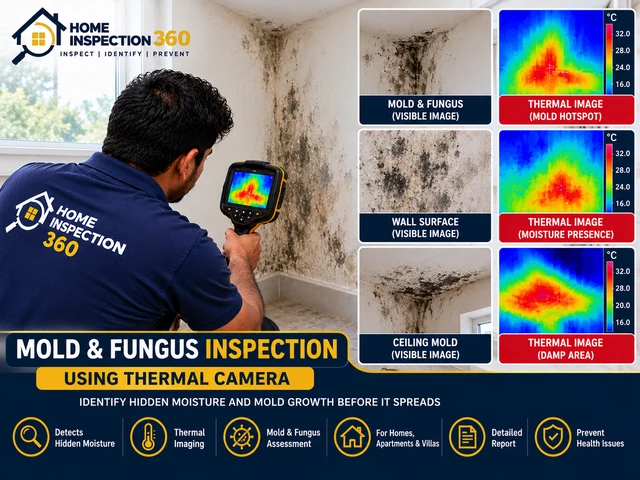
mold or fungus may appear as black, green, grey or white patches, speckled staining, peeling paint, damaged plaster or a persistent musty smell. Common locations include bathrooms, ceilings, corners of external walls, wardrobes, behind furniture, around windows, under sinks and areas affected by leaks or poor ventilation. Visible growth can recur if the moisture source remains unresolved.
Our inspection reviews visible mold-like growth and the surrounding conditions that may support it, including dampness, condensation, plumbing seepage, rainwater entry, ventilation and surface moisture. Moisture-meter readings and thermal imaging may support the visual assessment where appropriate, but neither tool alone proves that a patch is mold or identifies the species.
The service helps document the visible condition and likely moisture-related concerns so the owner can plan suitable next steps. It is not a medical assessment, a guarantee that hidden mold is absent, or a substitute for laboratory testing where that is needed.
It is a property-condition inspection of visible mold-like growth, musty odours, damp walls and ceilings, condensation and moisture patterns, with photo documentation and recommendations. It does not include laboratory mold identification or indoor-air sampling, it is not a health assessment, and it cannot guarantee that mold will not return.
We inspect accessible areas based on the symptoms reported and the agreed scope. We look for visible mold-like growth, dampness, staining, condensation clues and possible moisture sources.
Check accessible wall surfaces for mold-like spots, discolouration, peeling paint, bubbling, damp patches and musty odours. Surface appearance alone cannot identify the organism.
Inspect ceiling corners, slab edges and stained areas for visible fungal growth, water marks, flaking paint and moisture patterns that may relate to leakage or condensation.
Check accessible tile joints, ceiling corners, silicone edges, washbasin areas and poorly ventilated bathroom surfaces for mold-like growth and persistent moisture.
Review visible mold around room corners, behind accessible furniture, near windows and on walls where condensation or dampness has been reported.
Inspect accessible cupboard interiors, rear panels and nearby walls for musty odours, visible spots and moisture-related damage. Heavy furniture may need to be moved by the owner.
Check accessible window edges, frames, reveals and nearby walls for condensation marks, staining, seal gaps and mold-like growth.
Inspect accessible sink cabinets, utility corners, wall surfaces and pipe-entry areas for dampness, visible growth and signs that a plumbing leak may need separate investigation.
Review internal surfaces beside exposed walls, balconies and windows for damp patches or mold-like growth that may be associated with rainwater entry or failed seals.
Check accessible skirting, floor edges and room corners for staining, peeling finishes, dampness or visible growth. Hidden areas under fixed flooring are not confirmed by a visual visit.
Inspect accessible surfaces near AC units, drain routes and cool surfaces for condensation marks or dampness. Internal HVAC duct inspection requires separate access and scope.
Document moisture signs near plumbing routes and suggest further leak investigation if indicated. Mold inspection alone cannot confirm the exact concealed pipe leak source.
Review visible ventilation conditions, persistent condensation and damp-prone locations. Recommendations depend on the building layout and cannot guarantee that recurrence will be prevented.
With prior permission, inspect accessible affected common walls, corridors or service areas. Access to neighbouring flats and locked shafts must be arranged in advance.
Document visible mold-like growth and moisture concerns before occupancy or purchase, within the agreed inspection scope. This is not a guarantee against future mold growth.
Accept enquiries for accessible workspaces and commercial premises, subject to operating conditions, site access, safety and agreed scope.
Review reported history of recurring patches after cleaning or repainting and check for visible moisture clues. The underlying cause may need a plumber, waterproofing specialist or ventilation contractor.
Where suitable, compare readings on affected and nearby surfaces. Readings are indicative and can be influenced by material, temperature, salts and site conditions.
Record selected visible findings and explain areas needing further assessment. Photo coverage depends on access, lighting, site conditions and the agreed reporting scope.
The inspection starts with the reported history, where mold appears, whether it returns after cleaning, and any recent leakage, rainwater entry or condensation. We then visually assess accessible surfaces and look for moisture patterns that may help explain the conditions.
Visible inspection, moisture readings and thermal patterns may support assessment of damp areas. These observations are not laboratory confirmation of mold or its species.
These tools can help locate or compare surface symptoms. Thermal patterns show surface temperature differences, and moisture readings depend on the material and instrument. Neither method alone confirms the exact source of a concealed leak.
Suspected plumbing leaks, roof leaks, waterproofing failure, hidden cavities or indoor-air concerns may need a separate specialist test or trade assessment.
The summary may include areas inspected, visible mold-like growth, dampness clues, selected photographs, supporting readings where obtained, access limitations and recommended follow-up checks.
Laboratory sampling, indoor-air testing, opening-up work, mold removal, disinfection, plumbing repair, waterproofing, repainting and reinstatement are not automatically included. Discuss these separately before arranging any additional work.
The report records accessible visible conditions and relevant supporting observations within the agreed scope. It distinguishes visible findings from suspected moisture causes that may need separate confirmation.
Accessible rooms, walls, ceilings, bathrooms, windows, cupboards and other agreed locations checked during the visit.
Notes and selected photographs of visible spots, staining, discolouration or surface deterioration.
Observations of damp patches, peeling paint, water marks, condensation or moisture-meter indications where taken.
Thermal patterns observed where a thermal camera is suitable and used; these are indicative, not proof of mold.
Potential concerns such as plumbing seepage, rainwater entry, condensation or ventilation issues, identified as suspected where not confirmed.
Suggested follow-up such as plumbing checks, waterproofing assessment, ventilation improvement, qualified mold remediation or laboratory sampling if required.
We accept enquiries for mold, fungus, visible mold growth and dampness inspection in homes, apartments, villas, independent houses and commercial properties across Chennai, subject to availability and site access.
Contact us to confirm service availability, inspection scope, access requirements and charges for your property location.
T. Nagar, West Mambalam, Nungambakkam, Egmore, Kilpauk, Chetpet, Kodambakkam, Vadapalani, Ashok Nagar and Saidapet.
Adyar, Besant Nagar, Thiruvanmiyur, Velachery, Madipakkam, Nanganallur, Medavakkam, Pallikaranai and Perungudi.
Porur, Valasaravakkam, Virugambakkam, Mogappair, Ambattur, Avadi, Poonamallee and Iyyappanthangal.
Thoraipakkam, Karapakkam, Sholinganallur, Navalur, Siruseri and nearby apartment communities.
Palavakkam, Kottivakkam, Neelankarai, Injambakkam, Akkarai, Uthandi and nearby residential areas.
Tambaram, Chromepet, Pallavaram, Selaiyur, Sembakkam, Perungalathur and Vandalur.
Enquiries from Kanchipuram, Tiruvallur and Chengalpattu may also be considered depending on the exact property location and availability.
The inspection reviews accessible visible mold-like growth, staining, musty odours, dampness and possible moisture factors. Instrument checks may be used where suitable and included in the agreed scope.
We can document visible black or dark mold-like patches, but appearance alone cannot identify the species or its health risk. Laboratory sampling may be needed for identification.
Where suitable and available, these tools may help compare surface temperature patterns and moisture indications. They do not independently confirm mold or identify its species.
A standard visual inspection cannot confirm all hidden mold inside walls, ceilings, fixed cupboards or closed cavities. Further access, borescope inspection or specialist testing may be needed and is not automatically included.
Yes, accessible bathroom surfaces, ceiling corners, wall edges, window areas and other reported locations can be checked within the agreed scope.
We look for visible clues that may indicate leakage, rainwater entry, condensation or poor ventilation. The exact cause may require separate plumbing, waterproofing, building or ventilation assessment.
The inspection service documents findings and provides next-step recommendations. Cleaning, mold remediation, repainting, waterproofing and repairs are separate works unless explicitly agreed.
Laboratory mold identification and indoor-air sampling are not included in a standard visual inspection. If needed, ask about arranging a qualified specialist service.
No. It is a property-condition inspection, not a medical diagnosis or health-risk certification. For health symptoms or concerns, consult an appropriate healthcare professional.
No. Recurrence depends on controlling the moisture source, ventilation, temperature, materials and remediation quality. The inspection cannot guarantee that mold is absent or will not return.
Call or WhatsApp 9600696919 with your locality, property type, affected rooms and any history of leakage or recurring mold. Appointment timing, access, inspection scope and charges will be confirmed by phone before scheduling.
mold-like appearance and musty odour are not enough to identify a mold species or determine health risk. A standard inspection is limited to accessible areas and visible conditions. Hidden growth inside wall cavities, under flooring, behind fixed furniture or within HVAC systems may not be visible.
Moisture-meter readings and thermal images are supporting indicators and can be affected by material type, temperature, salts, surface conditions and site environment. Laboratory sampling, indoor-air testing, opening-up work, mold removal, disinfection, plumbing repairs, waterproofing and reinstatement are not included unless separately agreed. Do not disturb extensive mold growth; consider a qualified remediation professional for large or recurring areas.
Noticed black spots, recurring fungus, musty odours, damp walls or ceiling stains? Contact Home Inspection 360 to discuss a mold and fungus inspection for your home, apartment, villa or commercial property.
Please share your locality, property type, affected areas and any known leakage, rainwater or condensation history. Appointment timing and inspection charges will be confirmed by phone before the visit.
Home Inspection 360 accepts enquiries for mold and fungus inspection across Chennai and nearby districts, subject to appointment availability, property access and the scope agreed before the visit. Localities we cover include:
Locality not listed? See the full service areas page, call or WhatsApp +91 9600696919, or book an inspection.